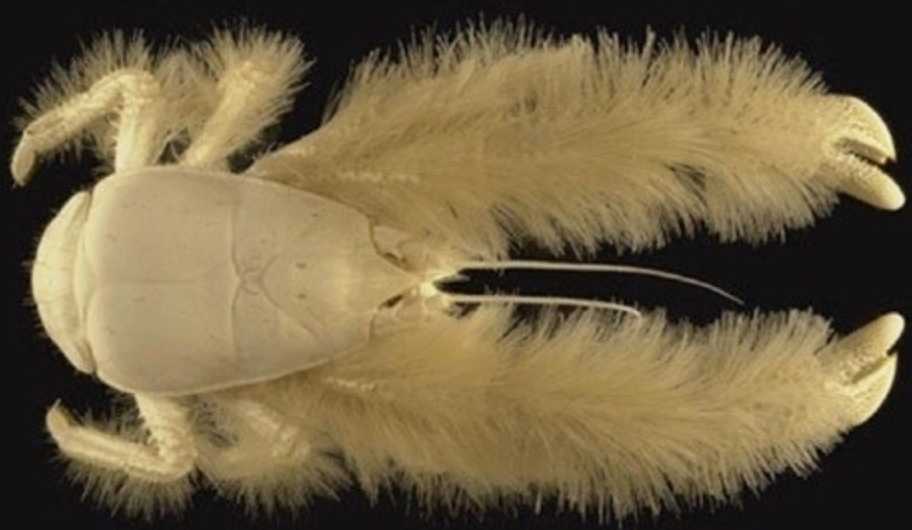
The Yeti Crab: Deep-Sea Marvel with Hairy Pincers and a Chemosynthetic Lifestyle


Animal Information
The Yeti Crab: Deep-Sea Marvel with Hairy Pincers and a Chemosynthetic Lifestyle

Discovered in 2005 near hydrothermal vents off Easter Island, the yeti crab (Kiwa hirsuta) is a crustacean unlike any other—renowned for its fuzzy, blond "hair" covering its pincers and body, earning it the nickname "yeti crab." This deep-sea dweller thrives in one of Earth’s most extreme environments, relying on a unique partnership with bacteria for survival.


Hairy Armor and Adaptations to the Abyss

  • Feathery Fibrils for Survival
    The crab’s most iconic feature is its dense covering of setae (hair-like structures) on its chelipeds (pincers) and thorax. These fibrils host colonies of chemosynthetic bacteria, which convert toxic hydrogen sulfide from hydrothermal vents into energy—a process called chemosynthesis. The crab "farms" these bacteria by waving its pincers in vent plumes, providing them with nutrients while feeding on their byproducts.
  • Blind but Sensitive
    Lacking functional eyes in the pitch-black depths, it navigates using sensory hairs that detect temperature, chemical gradients, and water movement. Its white exoskeleton reflects the faint light from vent fluids, while a stocky body (reaching 15 cm in length) withstands the crushing pressures of 2,200 meters below sea level.

Life in the Vent Ecosystem

  • Reproduction and Behavior
    Females carry fertilized eggs attached to their abdominal pleopods, protecting them in the toxic vent environment. Mating rituals remain unknown, but researchers suspect they communicate via chemical signals. Unlike many deep-sea creatures, yeti crabs are active crawlers, moving between vent fields to find optimal bacterial growth conditions.
  • Ecological Niche
    As primary consumers in vent ecosystems, they recycle nutrients and serve as prey for larger deep-sea animals like octopuses and fish. Their presence indicates the health of hydrothermal vent communities, which rely on chemosynthesis rather than photosynthesis as an energy base.

Scientific Significance and Conservation Concerns

  • Frontiers of Deep-Sea Biology
    The yeti crab’s discovery revolutionized understanding of life in extreme environments. Its bacterial symbiosis offers clues to early life on Earth and potential extraterrestrial life on ocean worlds like Jupiter’s moon Europa. Genetic studies show it belongs to a unique family (Kiwaidae), diverging from other crabs millions of years ago.
  • Threats from Deep-Sea Mining
    While currently listed as "Data Deficient" by the IUCN, yeti crabs face emerging risks from deep-sea mining operations, which could destroy hydrothermal vent habitats. Their specialized lifestyle makes them highly vulnerable to habitat loss, as they cannot survive outside vent ecosystems.


The yeti crab, with its fuzzy pincers and alien-like existence, embodies the mystery of Earth’s final frontiers. In the pitch-black, scalding-hot depths, it has evolved a survival strategy as remarkable as its appearance—reminding humanity that even in the most inhospitable places, life finds a way to thrive through partnership and adaptation.

Latest Stories
Entertainment News2 minute readAngela Bassett, the 2023 Oscar Honorary Award recipient, takes on a pivotal role in Christopher McQuarrie’s non-competition film Mission: Impossible – Dead Reckoning Part Two, where she reprises her character from Mission: Impossible – Fallout (2018) as CIA Director Erika Sloane, now elevated to the presidency of the United States. The film’s plot centers on a global threat posed by a sentient AI entity known as the "Entity," which seeks to manipulate humanity through digital dominance—a premise that gains eerie resonance in light of real-world political developments .
Sci-Tech News1 minute readOn July 16 local time, the U.S. Federal Aviation Administration (FAA) stated it has not considered replacing its existing contracts with L3 Harris Technologies and Verizon with SpaceX’s Starlink for aviation control systems. The FAA clarified it will not use Starlink or any satellite service as the sole communication technology for safety-critical air traffic services, nor will it abandon previous partners for SpaceX.
Entertainment News1 minute readGlen Powell, born October 21, 1988, in Austin, Texas, has evolved from a versatile character actor to a leading man, blending charm, wit, and intensity across genres.
Animal Information1 minute readBeneath the soft soils of Mexico, a creature that resembles a giant earthworm quietly resides. But don't be fooled by its appearance—this is no worm. It's Dermophis mexicanus, a unique amphibian with a surprising secret: its limbs have completely vanished over time.
Industry News1 minute readSAO PAULO, Brazil, June 25 (News Wire) – Brazil's retail sector staged a recovery in May, with foot traffic at physical stores rising 1.86% year-on-year, marking a significant turnaround from April's 3.99% decline. This rebound was primarily fueled by a robust 3.8% surge in street commerce, according to Seed Digital's Retail Purchase Intent Index (IICV Seed).
Sports News1 minute readWith the 2026 Milano Cortina Winter Olympics approaching, full schedules for Winter Sports World Cups and qualifying events are now available. The newly updated Sports Observer calendar includes 699 exclusive events for 2025 and 2026, plus select major competitions through 2034, serving as a key resource for athletes and fans.
Sports News1 minute readThe UK government announced on Saturday its support for London’s bid to host the 2029 Athletics World Championships, leveraging its rich experience in hosting top-tier sports events to bring the elite competition back to the iconic Olympic Stadium.